They say time travel isn't possible yet, but going to certain countries can feel like a reasonable substitute. For me, a Mexican woman, not exactly in a position to boast about how advanced we are, this trip to Cuba made that very clear.
Landing at Havana's airport, and then confirming it in absolutely everything around us, felt like stepping back into Mexico forty or fifty years ago.
As romantic as that might sound, and as nostalgic as it felt for us, there is something genuinely sad about realizing that a country like Cuba was once a country of wealth and greatness.
The arrival at the hotel was the first thing that threw us off. For one, you get used to being received with some warmth and attention, but Cubans don't feel entirely comfortable serving tourists, since nearly all of them are well-educated (just not in the hospitality sense), so in many places the staff look as if they're serving out a sentence. The man who checked us in at the Hotel Vedado had every feature of the classic Latin American government bureaucrat.
From there, the service in that hotel left a great deal to be desired compared to any guesthouse in Thailand, let alone a mid-range hotel anywhere else in the world.
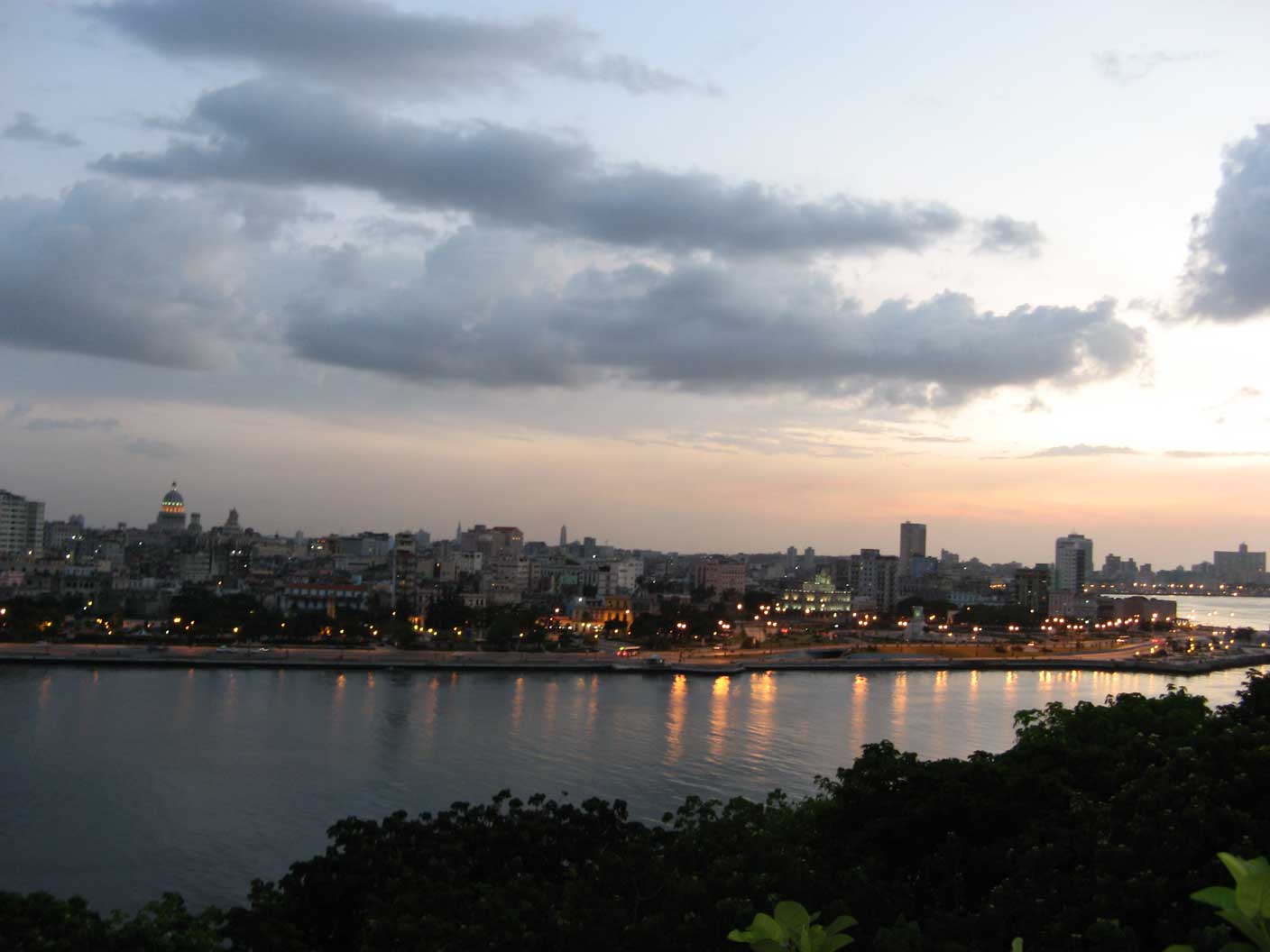
Havana is a genuinely beautiful city, which today, unfortunately, in the aftermath of what Cubans call the "Special Period" (the years when Russian aid stopped flowing into the country), carries a palpable undercurrent of anger.
People talk about that period a great deal, and it's clear that real hunger was suffered through it, from the nineties up through around 2002.
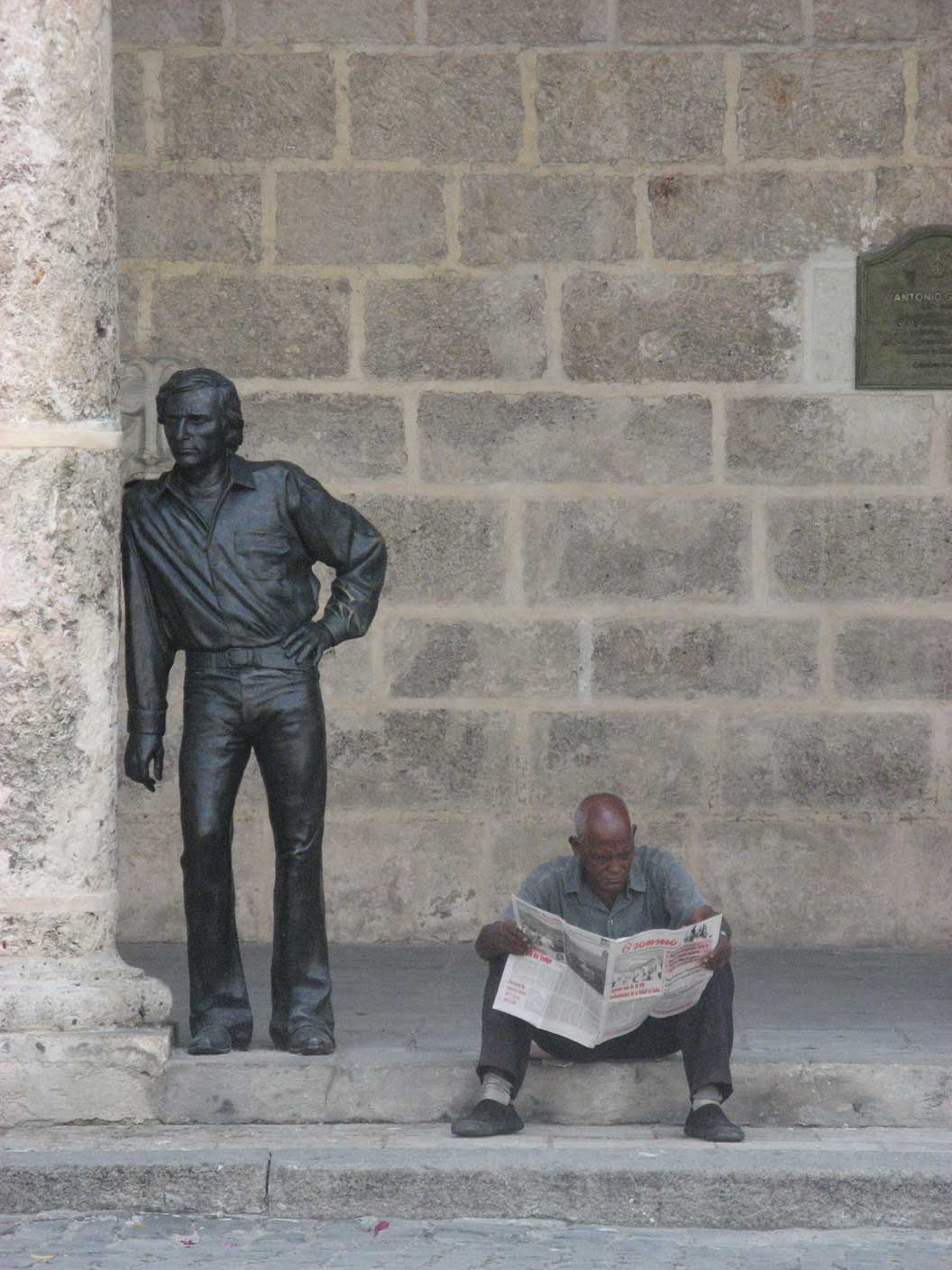
There is a great deal of poverty in Cuba, but there is no destitution. The terrible thing is that human beings adapt quickly to prosperity and far more slowly to losing it.
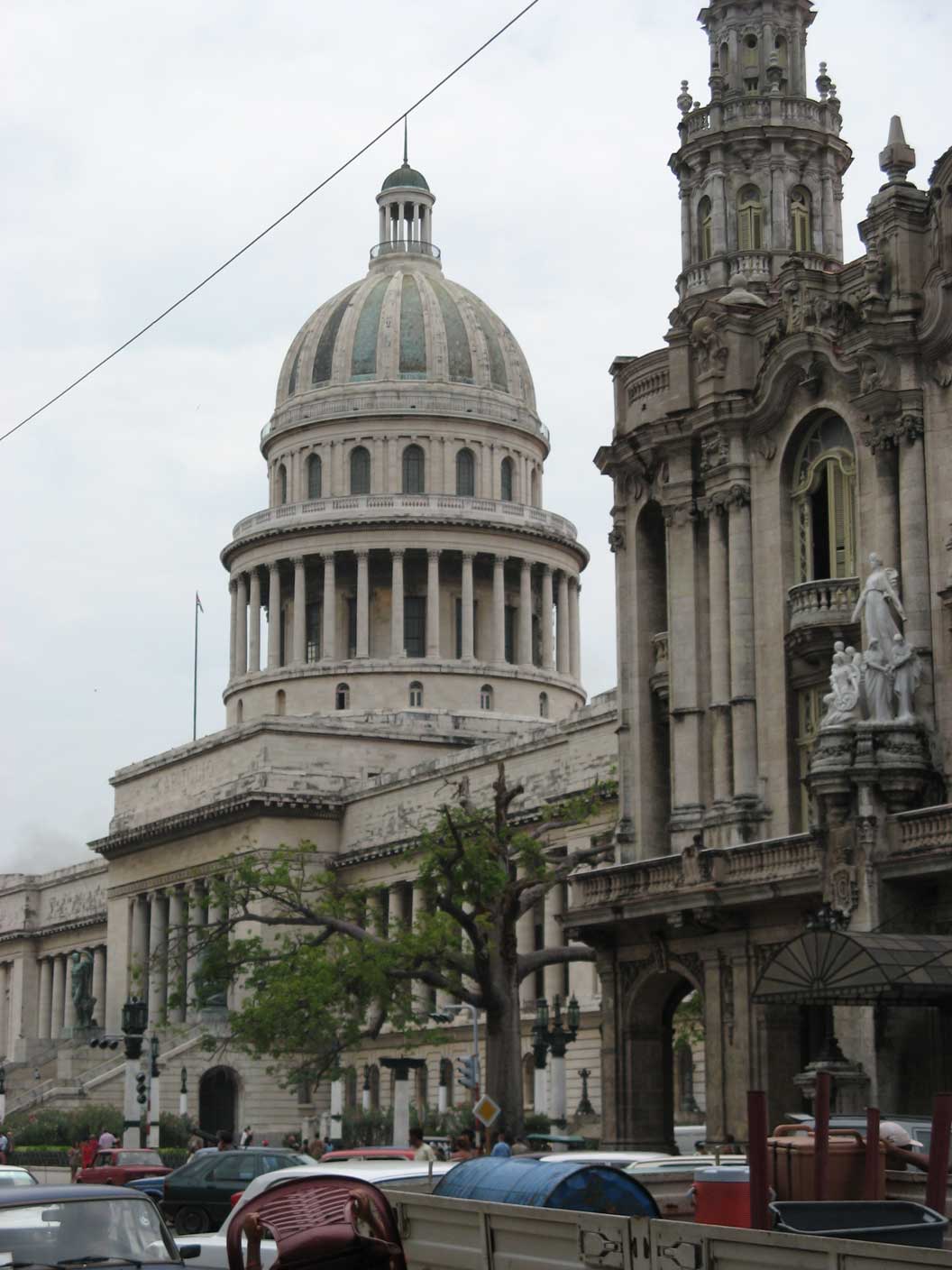
Old Havana is extraordinary. The architecture is magnificent, and fortunately money is being invested there, with those beautiful buildings under constant restoration.
The colors, the narrow but beautifully laid-out streets, all of it is stunning.
As my grandfather from Barcelona, who traveled to Havana during the Batista years, used to say: the layout looks very much like Barcelona.
The Malecón reminds me strongly of Veracruz, and perhaps Barcelona too, but the Barcelona that existed before the Olympics.
None of this stops people from singing, dancing, and enjoying life, because Cubans carry that in their blood.
Eating at fancy restaurants for tourists is a mistake, full stop: the food is bad and expensive. The paladares, however, are another story entirely.
These paladares, which are increasingly scarce these days, serve wonderful food because families simply open their front doors, set out a few tables (the permitted limit is twelve chairs), and cook their own traditional food. But for government reasons, many have been shut down and now operate clandestinely.
People approach you quietly in the street and, in a low voice, offer to take you to their homes for a proper Cuban meal, which might include excellent lobster.
Because we were traveling with our Cuban friends, we got to taste extraordinary things and drinks that only they know about.
At Héctor's house (one of our friends), we discovered malanga, a root vegetable somewhere between a potato and a sweet potato, used in all kinds of dishes. Sliced thin and fried, it becomes what they call tostones, though they also mash it and do other things with it. Delicious.
I had never tasted guavas like the Cuban ones: enormous, meaty, incredibly juicy. There was also a kind of oversized mango with the flavor of a Manila mango but without all the fiber.
Another fruit we'd never encountered, and which we loved, was the mamey de Santo Domingo, with a skin like a mamey but the color and texture of mango on the inside, and a flavor entirely its own.
What I fell in love with was a bottled malt drink made with unrefined sugar (what in Mexico we'd call piloncillo). Carbonated, it has a flavor that's hard to forget.
Our conversations with the various people we met in Havana gave us a fairly clear picture of what life there looks like today, and how Cubans themselves perceive it.
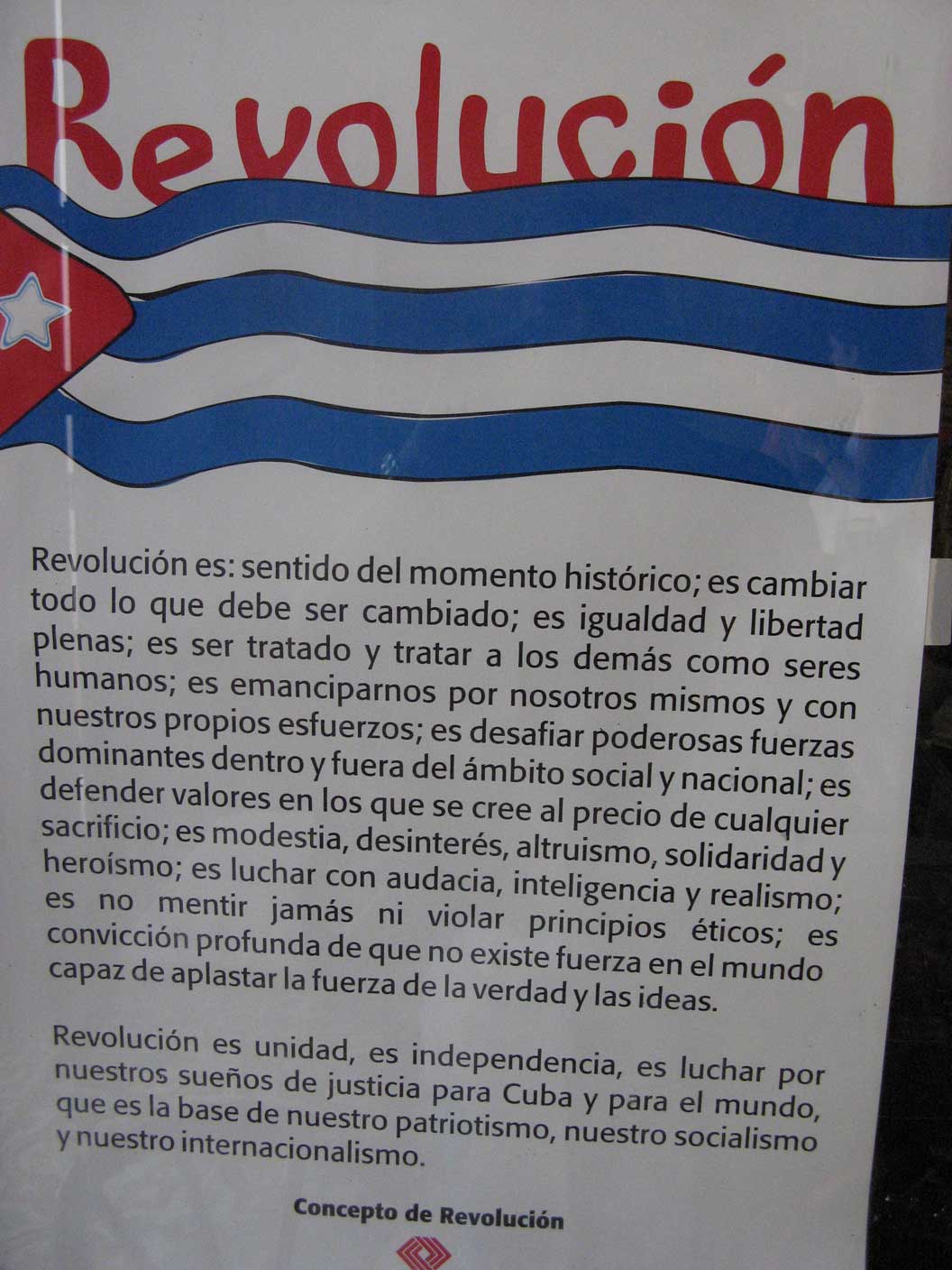
Héctor's parents belong to the Communist Party and fought with and for the Revolution. They are completely convinced that Cuba will move forward, because, they say, many programs are being put in place to make both industry and agriculture productive again.
I pushed back on this, pointing out that industrially there is almost no movement visible. Almost no trucks or freight vehicles on the highways, practically no ships coming into port.
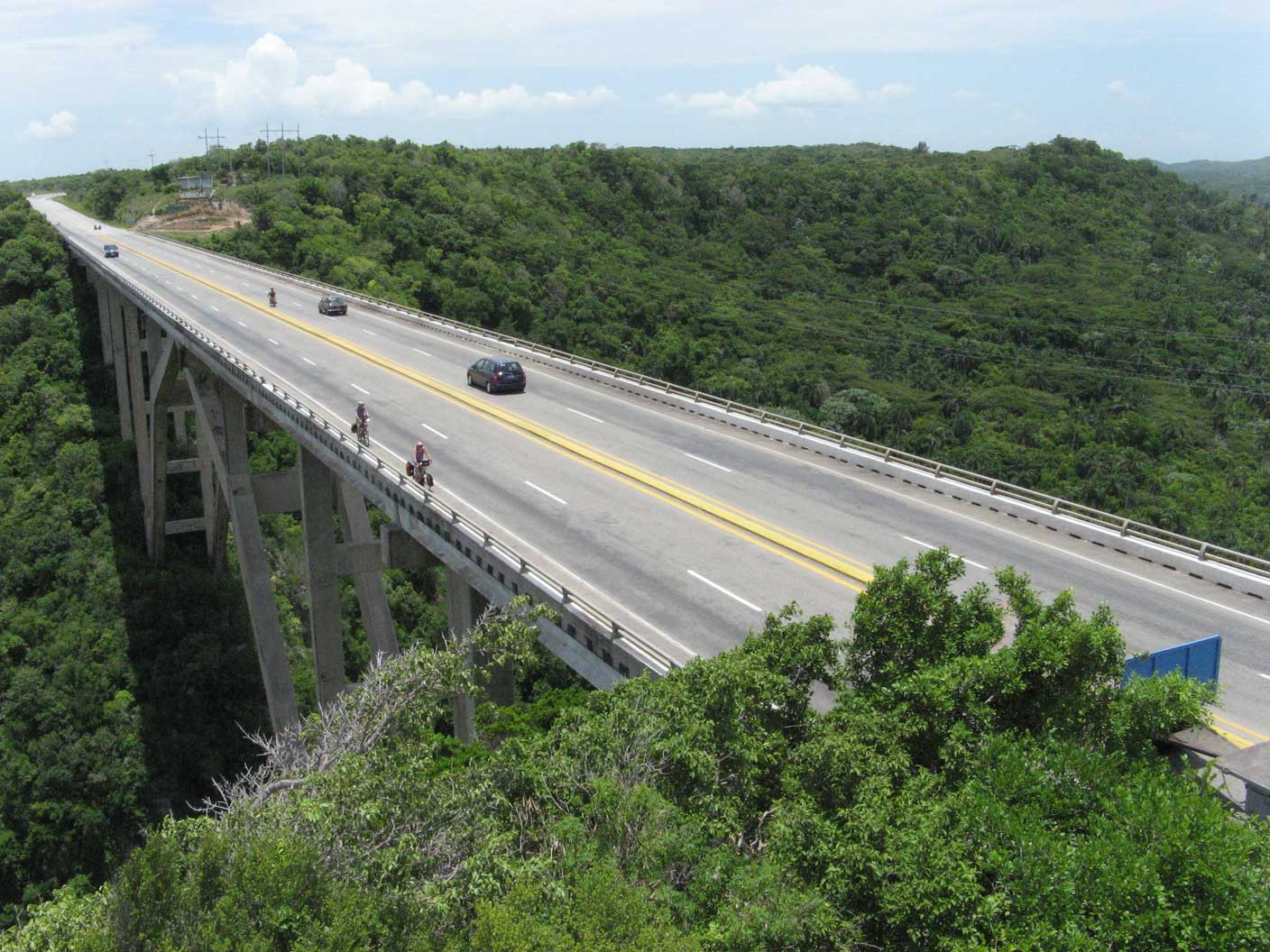
Almost none of the roads we drove, and we drove quite a few, are free of potholes, and there are essentially no road signs anymore. That alone limits you to driving only during daylight hours.
Public transportation is scarce and unreliable. At bus stops, dozens of people stand around looking bored, waiting for buses that show up whenever they feel like it. When one finally appears, people run, cluster together, and many still don't make it, forced to wait for the next one or to pedir botella (the Cuban term for standing on the road with your thumb out, hoping someone will take you in their car).
On the highways this is even more visible, and you frequently come across clusters of people at certain points, looking at you with that unmistakable expression of "why won't you give me a ride when you clearly have space?" It's a logical look, in a country where it is supposedly guaranteed that everyone has equal rights to everything.
To enforce this, there are police officers dressed in yellow whose job is to compel drivers with government license plates (not tourist or diplomatic vehicles) to pick up passengers if there are visibly empty seats.
These days it's noticeable that many Cubans have more hard currency than before, obtained one way or another.
In some cases it comes from working directly or indirectly in tourism; in others, from relatives sending money from abroad.
It turns out that just a few months ago, Cubans were finally permitted to enter the shops, restaurants, and hotels that were previously off-limits to everyone but tourists.
If a Cuban pays in CUCs (the convertible peso, pegged somewhere between the dollar and the euro), they can shop in better-stocked supermarkets, eat at certain restaurants, or pay for a day at a hotel pool and its facilities.
Still, at hotel entrances, instead of a doorman who warmly opens the door and says welcome, what you find are men who look like, and I believe actually are, plainclothes police. They monitor who comes and goes.
The building housing the United States Interests Section in Havana is large, heavily guarded, and fitted with an illuminated sign the size of the building itself, facing the Malecón. On this sign, accusations scroll by in red letters, denouncing the Cuban government's supposed mistreatment of prisoners and its disregard for human rights.
On this particular point, at least to me, it seems equally fair to note that other nations that call themselves civilized and democratic, often with a license to kill, commit acts just as unjust and inhumane. That said, it is clear that in Cuba, everyone eats, everyone is clothed, everyone has medical attention, and everyone has a roof.
Of course, while everyone is very equal, some are more equal than others, as you can see in the glaring difference between ordinary people's homes and those of politicians or diplomats.
These are proper mansions, surrounded by carefully trimmed greenery, most of them concentrated in the neighborhood called Miramar.
Photography is not permitted there, and we managed only two photos, none of the finest houses.
The people we met through our friends who have careers as historians, philosophers, doctors in various fields, know that their advanced education gives them more opportunities to travel abroad and share their ideas and research, and this gives them something to hold on to. Because in general, people in Havana doing any kind of work, as taxi drivers, employees, whatever, feel deeply demoralized.
Most of them, once they feel comfortable enough to speak freely, start to complain, because nearly everyone here has some level of education and is therefore not a country of sheep content with whatever they're told.
This could be Cuba's great opportunity, as it seems to be opening up slowly to the wider world and the reality of competition.
The risk, of course, is that almost nobody is accustomed to working very hard, though to be fair there is no incentive, and that could change if there were one.
We didn't dare photograph the parts of the city that are in truly bad shape, out of respect for the people watching us with expressions of exhaustion and sadness. That part of the trip weighed on us, even as we acknowledged everything that has been achieved overall. It seems that sacrificing for those who have less is not something that comes naturally to us as humans, and the desire for more and for a better life is always there.
Even more so now that, with a little more freedom, people can compare and hear how one can compete, and sometimes earn more money and find success in the capitalist world.
While many Cubans are genuinely convinced that with their education and intelligence they will quickly succeed in that world (and many have proven exactly that), they don't always see that in 2008, the struggle for survival in these countries that call themselves free and competitive is neither as clear nor as fair as it sounds, because monopolies and oligarchies today make it nearly impossible for small entrepreneurs or independent-minded people to grow, and you end up having to sell yourself entirely to multinationals or endure things that will sometimes make you miss exactly this kind of paternalistic government.
The national channels, I would say, are actually better than what we have in Mexico, and there's no comparing them to the cable channels in the hotels, which carry channels from all over the world.
We heard wonderful music and rhythms everywhere.
We walked through the famous Callejón de Hamel, decorated by an artist named Salvador. The alley is a vivid expression of the syncretism in Cuba between Catholicism and Voodoo (Santería).
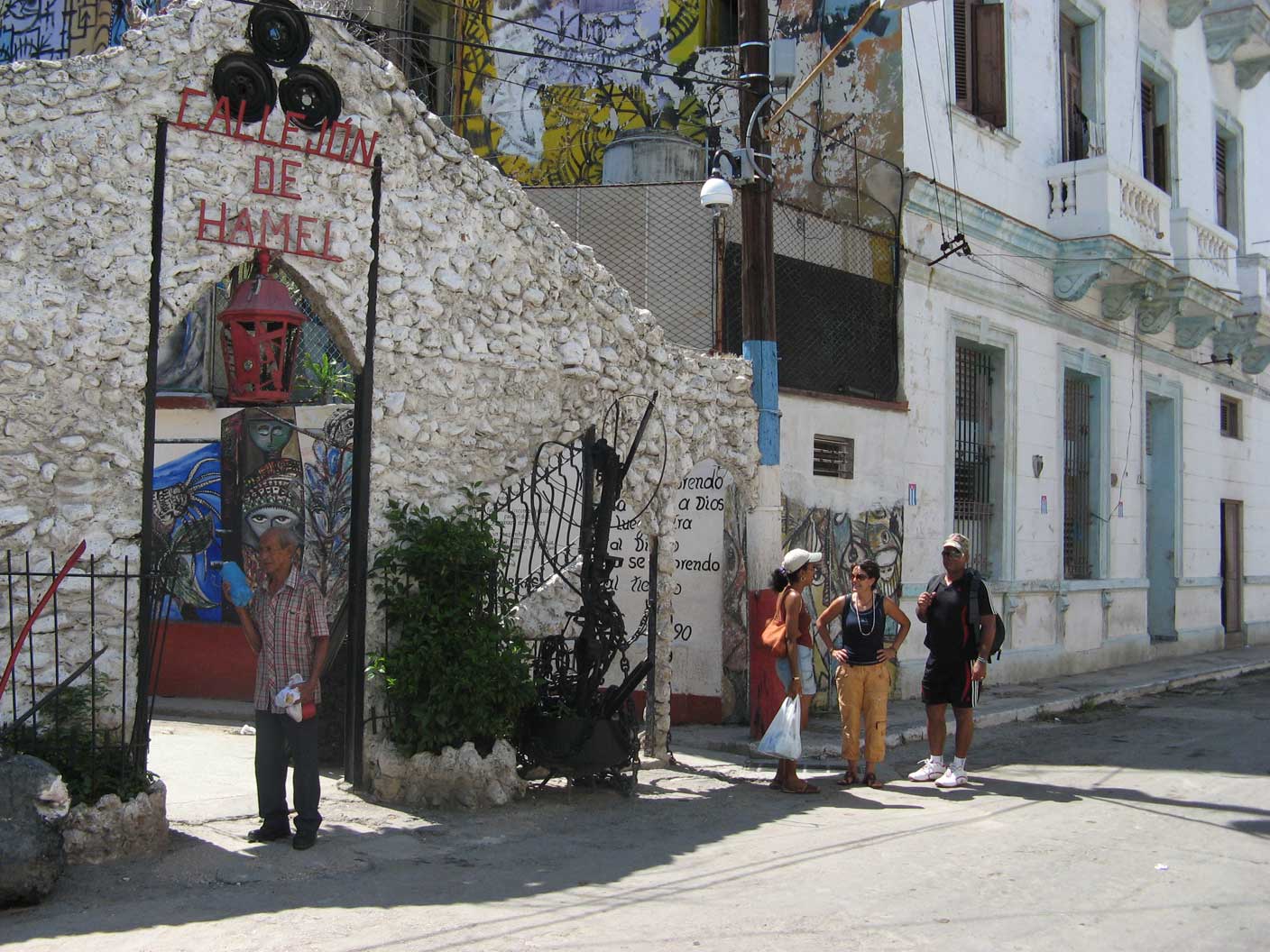
Some of them feel as if they belong to the Tao (the Way).
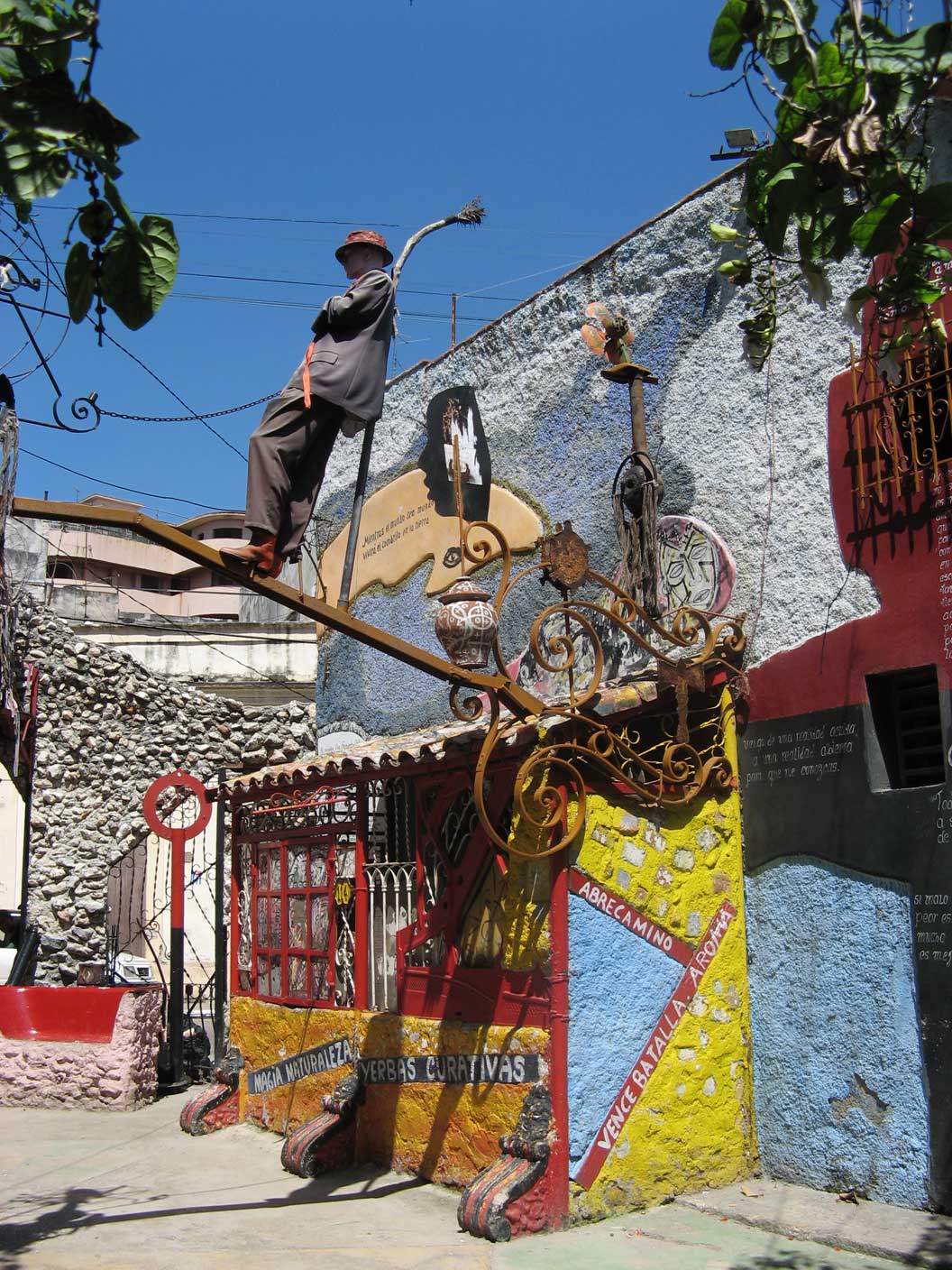
Here you'll find the studio where Salvador works and sells his pieces, and the work is excellent: paintings of the saints in Santería, deeply expressive, saturated with the African influence on Cuban culture.
I am an atheist and have no connection to any religious belief, but I'll confess that there is a strange and powerful energy in Cuba, and especially in that alley.
The Museo de Bellas Artes, right in the heart of Havana, is not to be missed, and especially the section dedicated to Cuban art, which holds some extraordinary pieces. This is another of the country's real strengths, its artists, and this beautiful museum is genuinely world-class. The museography is excellent; my only small criticism is the lighting in a few corners where graphic works are displayed.
A short walk from there, you can visit the museum where the yacht is exhibited, the one on which Fidel Castro, Che Guevara, Camilo Cienfuegos, and others launched a revolution in 1957 aboard a boat this small, to overthrow the dictator Fulgencio Batista, who had been installed by the United States.
This is the Museum of the Revolution, and inside you can move through several rooms filled with newspaper clippings, leaflets, and a great many interesting photographs from the period. Though one can't ignore the deterioration of the building itself, or the way in which the material, while fascinating in parts, is at many moments heavily one-sided (as tends to happen with all kinds of fanaticism) in its framing of opposing ideals.
Because this trip was so intense and so full, I'll write a second part about our travels to the provinces we visited. More soon.
Sanuk
Comments (1)
Amiga, me parece muy interesante tu comentario sobre Cuba, de una manera muy inteligente e interesante como te caracteriza, has logrado captar nuestra realidad. Es que no pararon en ese viaje y vivieron intensamente los dias que estuvieron de visita.
New comments coming soon.