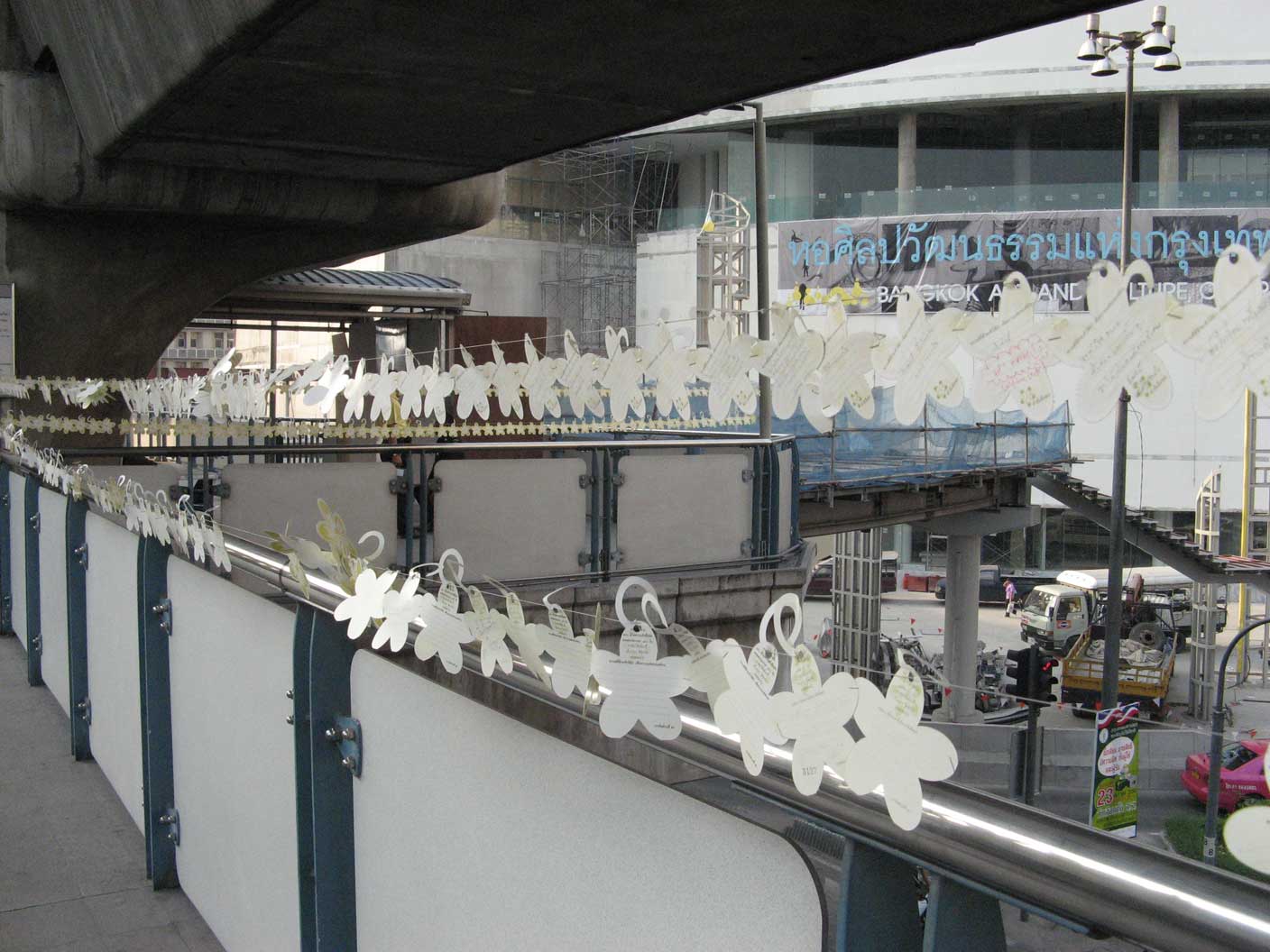
This year, because it was his 80th birthday and his health has been fragile, people have been expressing their affection for him all year long.
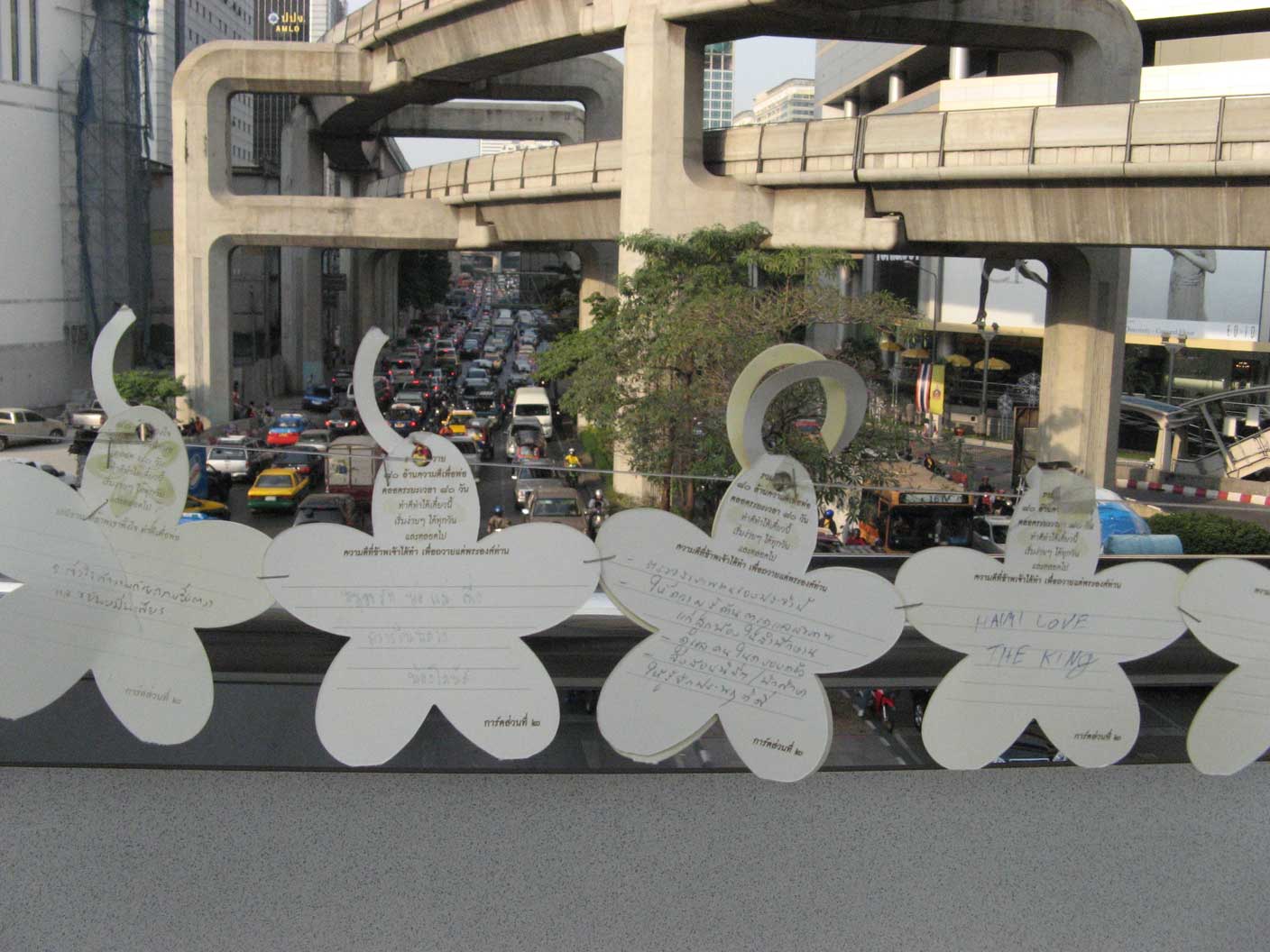
Along the walkways of the BTS (the elevated train), people hung hundreds of small slips of paper covered in warm messages and good wishes, written in both Thai and English.
Below you'll find a few photos of something that drew a great deal of attention.
On Thursday, January 3, 2008, the King of Thailand's sister passed away. She was his only surviving sibling; there had been three of them, but the eldest brother, who ascended to the throne in 1935 and held it until 1946 as King Ananda Nahidol, Rama VIII, was ten years old, had been born in Germany, and died in 1946. In 1945 he had returned to Thailand after studying in Switzerland to take his place on the throne, but in June of that year he was found dead in his bed in the royal palace, a gunshot wound to the head, and whether he took his own life or was murdered has never been established. His brother's death was the reason the current King, Bhumibol Adulyadej, known as Rama IX, came to occupy the throne and has reigned over Thailand for 61 years.
Bhumibol Adulyadej was born in Cambridge, Massachusetts, while his father was studying medicine at Harvard University.
The young king completed his education at the University of Lausanne in Switzerland before returning to his country to take the throne.
He married the daughter of Thailand's ambassador to France, Mom Rajawongse Sirikit. They wed in April of 1950.
It is said that he has governed with "Dharma" (the Buddhist principle of righteous conduct) in order to bring benefit to his people.
He is an accomplished saxophonist, a lover of jazz and the arts, and an excellent photographer.
When you live here in Thailand and you haven't grown up with an entire people's devotion to its leader, none of this is easy to grasp. It takes time to begin to explain it, and even then what I can offer is only my own point of view as a foreigner, an observer, someone curious about the society she has landed in the middle of.
The King is the most important person after Buddha, and so the reverence shown him goes well beyond anything you might feel toward other monarchs or world leaders.
There genuinely seems to be a deep esteem for this King, who has involved himself directly with his people on many projects.
Everywhere you go, including private homes, people tend to keep a photograph of the King or the royal coat of arms somewhere on the wall.
The days of the week each have a specific color assigned to them in the Buddhist calendar, and yellow belongs to Monday. Since the King was born on a Monday, Thailand has been dressing itself in yellow for 61 years now. Especially on Mondays, as I've mentioned in other posts, people wear at least a yellow polo shirt bearing the royal crest, in honor of and solidarity with their King. This, as I've also noted before, is one of the first things that catches your eye when you've just arrived in the country.
Since the beginning of his reign there have been several coups d'état, and the most recent one, which we happened to witness and have already written about, only made people wear yellow more insistently, as a way of showing their support for the monarchy.
This is entirely voluntary, though I'm not entirely sure whether in some government agencies it forms part of the official uniform, because you frequently see a great many people who work in those agencies wearing yellow every single day of the week.
The death of Princess Galyani Vadhana made the general mourning of the Thai people impossible for us to miss.
We went out to eat and found very few restaurants open on the streets near where we live (and I'll remind you, we live in an area densely populated by people close to the Crown), with black dominating everywhere and faces to match.
There will now be something like a hundred days of mourning, during which no celebrations of any kind will be held, because this sister was very close to the King.
It was for this reason, in fact, that the King had been living in Bangkok while she lay hospitalized for nearly a month with the cancer that ultimately claimed her, and the traffic consequently became much heavier at times. Whenever he, his family, and their motorcade move out from the palaces or through public spaces, vehicle traffic comes to a complete stop with near-perfect coordination, and even pedestrians freeze in place to clear the way.
Since we walk frequently through the streets near one of the palaces, we've witnessed this many times, and it still surprises me today.
Everything stops. The police, with perfect courtesy, ask you to stand still, and the cars pass through at high speed, or simply enter and exit the palace grounds.
The King and his guard always travel in yellow Mercedes-Benz vehicles. His son (possibly the next in succession), by contrast, travels in red BMWs.
One of the princesses, I'm not sure which, moves about in white automobiles.
One day we happened to see a teenager walking along talking on his mobile phone. A police officer signaled him to stop, and when he tried to sit down on a concrete ledge, the officer immediately gestured for him to remain standing.
The boy obeyed at once, with complete respect, which surprised us, given the times we live in. In Thailand there is still a great deal of deference shown toward authority, hierarchy, and elders.
The greeting, as many people know, consists of pressing the palms together and bowing the head over them. But this varies depending on who you are.
For example, if an older person walks by and the young people around them (which almost never happens) fail to offer this bow, the elder will certainly not offer it first.
But if an elder does want to return the gesture of courtesy, they will never bow as deeply as the younger person is expected to bow before them.
The same principle applies when the hierarchy is more pronounced in a workplace context, and so on down the line.
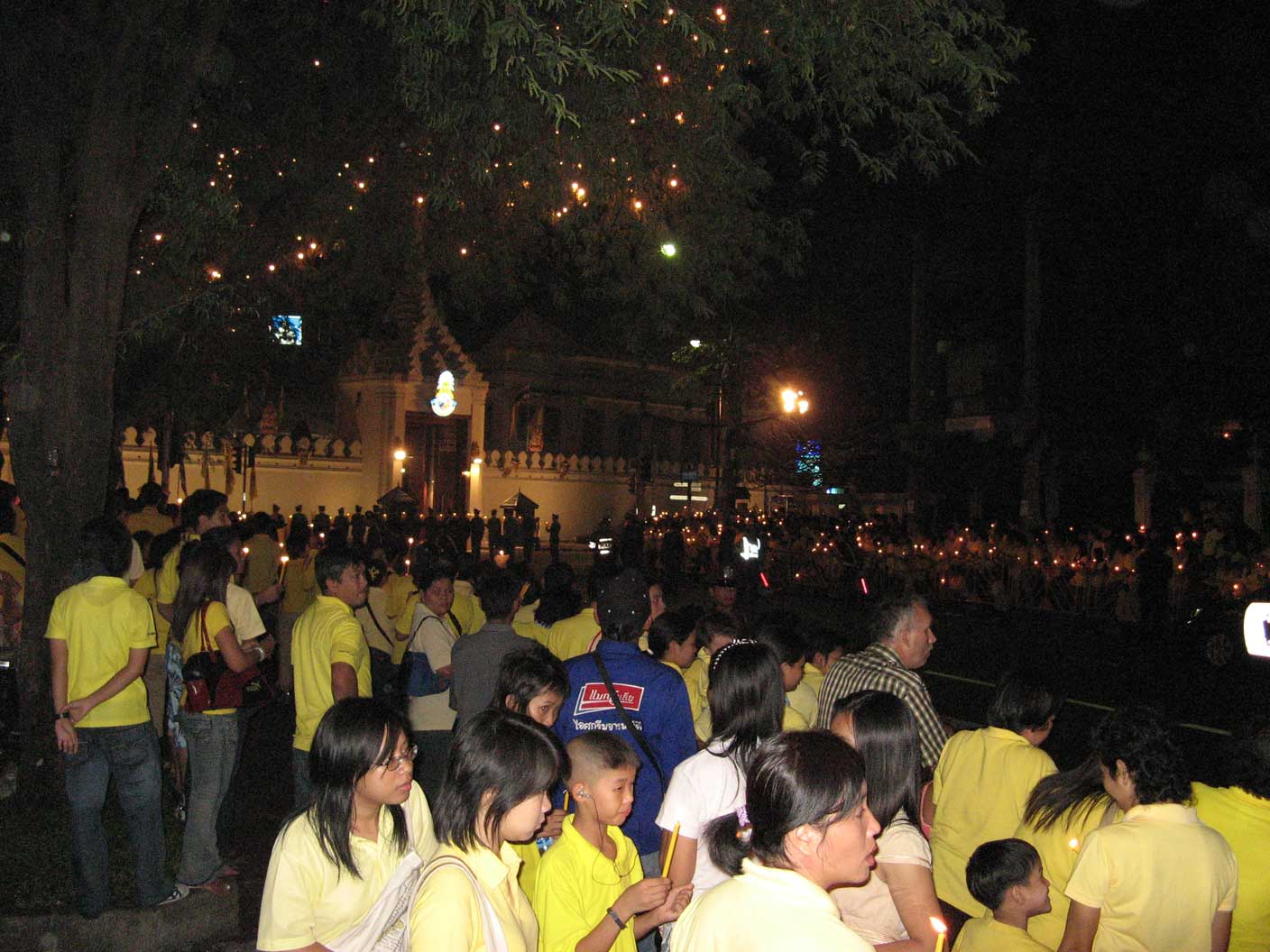
The King's birthday is also Father's Day. By the same logic, the Queen's birthday is celebrated as Mother's Day.
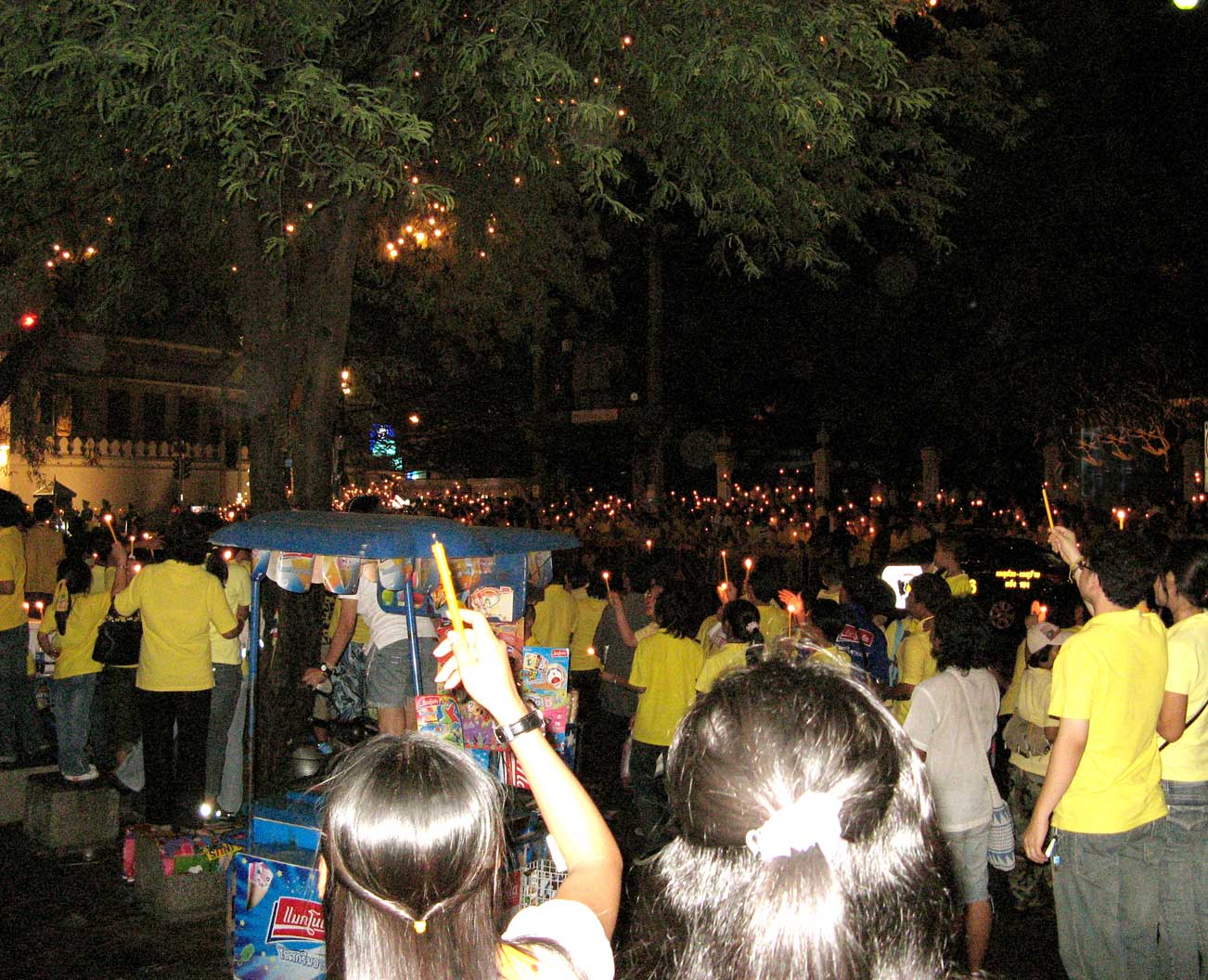
His birthday is celebrated in grand fashion, and people spontaneously crowd into the streets, especially in front of the palace, to celebrate, sing, and salute the King.
They sing songs, there are fireworks, and candles are lit, the typical Buddhist candles sold everywhere, in yellow.
We ventured out the first year we were here for this celebration, but this year we preferred to watch the fireworks from our balcony and let the music reach us from a distance.
The crush of people, much like on Chinese New Year, was simply too much, and we had no desire to repeat the experience.
I should note that the Thai people surprised me once again with their decency and good conduct at these events. Everyone is respectful, and I have never seen anything unpleasant.
I, standing in the middle of the crowd, began to feel claustrophobic and asked Juan if we could try to make our way out as quickly as possible. It was genuinely moving to feel people opening a path for us as soon as they saw the look of panic on my face, doing what they could to let us through.
As a conclusion, all I can say is that the figure of the King and Buddhism are the twin engines of this society, one that seems to function better than many others, at least when it comes to how people treat one another. I think that is the reason for the deep sense of safety you feel on the streets of Bangkok and other Thai cities. It really doesn't seem to come from police repression, but from a genuine, internalized conviction that other people deserve to be respected.
Sanuk
Comments (9)
Enhorabuena por el blog. Yo también vivo en Tailandia. Llegué hace 3 meses para abrir la corresponsalía en el Sudeste Asiático del diario REFORMA. HE contactado con varios ciudadanos mexicanos que viven en Tailandia y me encantaría almorzar también un día con ustedes para intercambiar impresiones sobre este lugar fascinante. Les mando un cordial saludo y mi dirección de correo electrónico para que me puedan contactar, si les apetece.
Ángel Villarino
anvillarino@hotmail.com
www.reforma.com
Querida amiga:
Muy interesante lo que cuentas sobre este pais que hemos hecho nuestro, es cierto que es bien impresionante la devocion de este pueblo por la figura del Rey y el sentido tan alto que tienen del respetuo mutuo. Una de mis colegas francesas dice que luego de vivir un tiempo entre ellos nos volvemos mas educados y pacientes....
Un abrazo y como siempre un placer leer tus historias.
Alex
Te quiero recomendar dos blogs de amigos cubanos, se que los vas a disfrutar:
Mi vida magica. De mi amigo Jose Tadeo Tapanes Zerquera y el de mi amiga Yvette que esta en las paginas amigas de mi blog.
Hola, he esto leyendo un poco tu blog y me han venido unas cuantas preguntas a la cabeza. ¿sabes cuanto dinero mensual hace falta(más o menos) para vivir en bangkok? ¿y en otras ciudades de tailandia? ¿sabes cuanto puede costar el alquiler de un piso?
¿sabes si en las universidades ofrecen alojamiento? ¿es muy dificil el tailandes? ¿cuanto tiempo, aprox, se puede tardar en hablarlo lo suficientemente bien como para,por ejemplo, entender lo que dicen en la tele? ¿sabes si en bangkok hay algún sitio para aprender thai los españoles? ¿dan cursos de menos de un año de thai en alguna universidad?...
Muchas Gracias. Espero no abusar demasiado de tu tiempo. Un saludo.
Hola Miguel,
La cantidad de dinero que hace falta para vivir en Tailandia depende mucho del nivel de vida que quieras llevar. Un guest house te ofrece una habitación decente con baño desde 500 baths por día. El piso que yo ocupo en Bangkok, es amueblado y tiene además de la estancia con sala y comedor, una pequeña cocineta completa y una recamara de buen tamaño. Un baño completo en la recamara y medio baño en la estancia. Todo el piso esta amueblado y pago con todo y energía eléctrica unos 18000 bahts mensuales. No es caro ya que no se encuentra cerca de las líneas del metro o del tren elevado. Creo que puedes encontrar algunas cosas mas baratas y ciertamente muchas mas caras.
Para mi estilo de vida (que no es suntuoso) creo que puedes vivir en Bangkok con unos 2500 dólares mensuales. Tal vez menos.
No tengo idea sobre si las universidades ofrecen alojamiento. Para mi, que hablo cuatro idiomas, el ablandes ha resultado bastante difícil pero supongo que es que tampoco me he fijado como prioridad el aprenderlo. Llevo mas de un ano en Tailandia y aun ahora no puedo entender lo que dicen en televisión sino que mis conocimientos del idioma apenas son suficientes para desplazarme sin problemas, comprar casi todo lo que necesito, comer y pedir las comidas. Si, hay muchos lugares donde aprender el tailandés y conozco gente que en un ano habla el idioma con bastante corrección. Algunos de ellos hasta lo leen y escriben aunque no todos.
Saludos
Estimado Juan, un gusto enorme que sigan disfrutando de su aventura. Saludos desde Sonora.
Hola Pedro. Gusto de escuchar de ti. Sigues con la misma direccion de correo electronico. Yo si tengo la misma, si cambiaste la tuya, enviame un mensaje. Un abrazo. Juan
He caído por casualidad en el blog. Me ha parecido muy interesante la aproximación que haces del pueblo tailandés. Veo que la entrada es de hace unos años, ¿sigues viviendo en Bangkok?
Gracias por compartir esto, un saludo afectuoso
Gracias por tus comentarios a nuestro blog, pero como bien dices ya hace tiempo y ya no vivimos en Bangkok.
Ahora estamos nuevamente en Mexico desde hace dos anos y nuestro hijo que vivio 4 anos en Bangkok, tambien llego en Septiembre del ano pasado.
Tenemos una compania de importacion y exportacion con Asia y ahora es mas importante estar aqui, pero extranamos ese increible pais que hoy tiene problemas.
Como tenemos negocios con Tailandia, esperamos volver a pasar un tiempo alla.
Por lo pronto escribimos sobre Mexico y despues de haber vivido fuera, desde otro punto de vista.
Saludos, Sanuk.
Tengo 75 años pero a los 19 en un viaje a Londres conocí por un tiempo a un joven llamado "Woody" de sobrenombre que era uno de los hijos del rey de Siam. Estaba estudiando enb Londres despues de venir de Suiza y Francia. El quería quedarse en Europa ya que la pasaba muy bien. Me lo presentó mi amigo Jim Scott en el Guy·s Hospital de Londres. Era pariente o no del rey de Siam? Gracias por averiguar. jc. jcschamis@ciudad.com.ar
New comments coming soon.