After a year and a half, I finally make another attempt at four days of not quite complete silence, but Noble Silence, at a Buddhist monastery here in Mexico. We left Cuernavaca, my cousin and two of her friends and I, to pick up the son of one of them in Cholula. After a generous breakfast there, we headed toward the village of Coacoatzintla, about 10 kilometers from Xalapa. Waiting for us was a man who, together with his wife, looks after the Venerable Bhikkhu Nandisena, who lives at this monastery, which has been sustained for years by donations that, in recent years, have been dwindling.
One of my cousin's friends, Vicky (along with a few others), is responsible for the care and upkeep of the place. As tends to be the case at Buddhist centers like this one, contributions are voluntary, but on this occasion a modest fee had been set, which struck me as a good idea, because unfortunately here in Mexico there is never any shortage of people who show up and leave nothing behind.
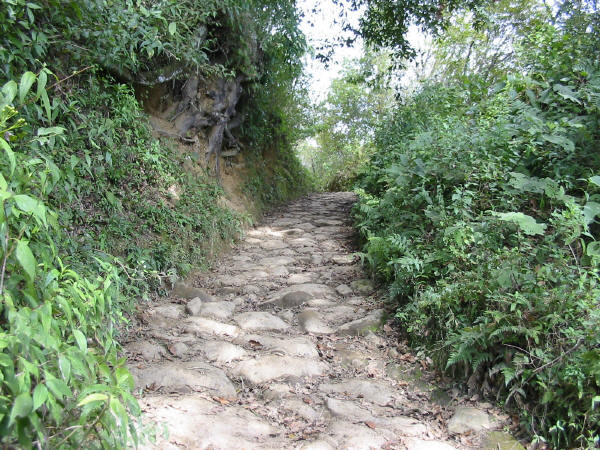
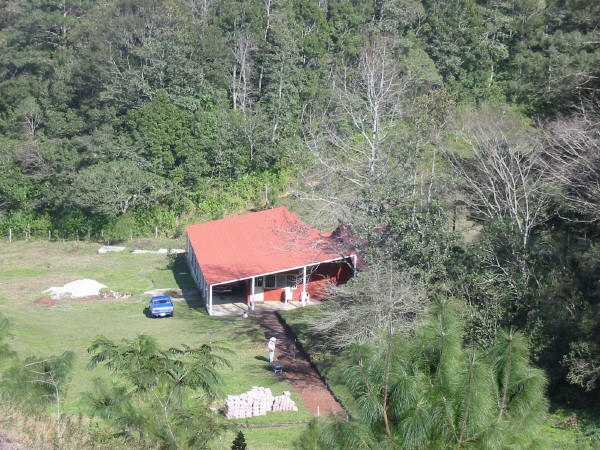
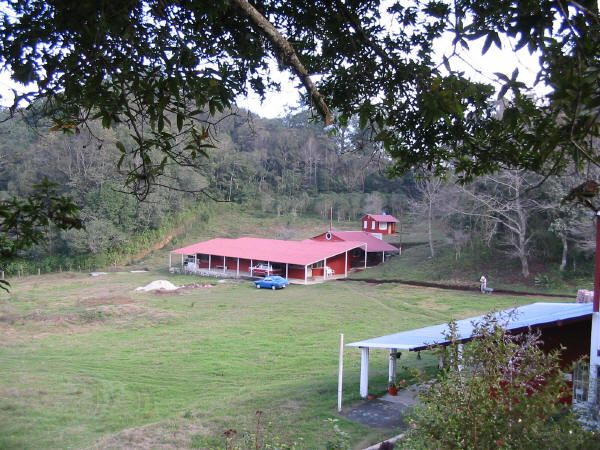
In Juan's truck (he's the man who collected us), we set off down a dirt road for several kilometers before finally arriving at this beautiful place. Perched on a kind of plateau ringed by mountains, a handful of simple structures rise up to form the monastery. Whatever its modesty, the small temple struck me as utterly charming. A large, handsome Buddha sculpture, wooden floors, incense, a quiet atmosphere, the smell of open countryside, and suddenly the desire to meditate arrives all on its own.
The first thing we do after leaving our things in the designated rooms is go and meet the Venerable Bhikkhu Nandisena.
He is a tall, solidly built man dressed in his violet tunic, and he receives us with one of those smiles I have only ever seen on monks and Buddhist practitioners.
The Venerable serves as Abbot of the Dhamma Vihara monastery in Mexico. He is Spiritual Guide of the Mexican Center of Theravada Buddhism, A.C., Mexico's representative to the World Conference on Buddhism, and editor and translator of several books from Pali into Spanish, among them "Pali Roots in the Saddaniti."
Bhikkhu Nandisena captivates me immediately, his personality amplified by a deep and expressive gaze that a pair of beautiful blue eyes does nothing to diminish. He is originally from Argentina and lived for many years in Burma before finding himself in Xalapa, sharing his teachings with whoever wishes to receive them. That afternoon we had a very easy, relaxed talk, getting to know one another and the place, and committing to the rules (nowhere near as rigorous as the ones I submitted to in Thailand) that would govern our four days.
Being the scatterbrained person I am, even after having walked the whole place, I managed to get lost on my way to the first evening meditation in the temple.
The floors are wood, and apparently my footsteps could be heard from the temple as I wandered, quite unintentionally, along the upper corridor where the Venerable's quarters are. He, to his great credit, simply got up from his meditation and came to find me, which left me feeling mortified and rescued in equal measure.
The food, mostly vegetarian (though one day they served fish, on doctor's orders for the Venerable), was delicious. Vicky, Mónica (my cousin), and Celia planned and cooked the meals. Víctor and I were assigned different tasks: he swept and cleaned the outdoor areas, while I was in charge of arranging, replacing, and tending the flowers in the vases in the temple and in the Venerable's dining space.
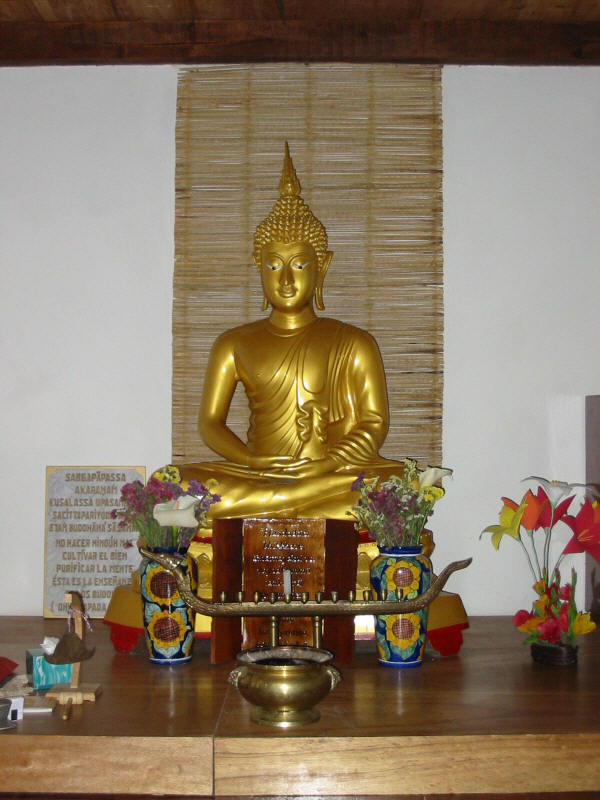
This space also held an interesting Buddha sculpture alongside several others, various flower arrangements, and an equally pleasant atmosphere. The one genuinely uncomfortable aspect of everything was the brutal cold, because the wind slipped in from every direction and the fields woke up frozen each morning. Again, due to my own inattentiveness, I didn't notice that first night that my window had stayed open, and I nearly greeted the morning as a block of ice. That first morning, around 7 a.m., after meditating and having breakfast, I had to touch water and nearly turned into a snowman on the spot.
It was a real pleasure to be in the Venerable's company and to share with him not only his teachings but also the two meals we took each day.
As in all these retreats (which I described in more detail back in August 2007 when I took my first course), you have a great deal of time alone with yourself, and it becomes a kind of psychoanalysis. Being the restless person I am, always wanting to look at everything around me, I don't think I left a single hillside or open stretch of ground unexplored. The insects, the plants, the mushrooms, the two dogs and the cat that lived alongside us all became objects of my attention and company. Víctor also liked to explore those hills with his camera (he's a photographer), so we occasionally ran into each other out there.
I deepened my meditation practice and learned to meditate while walking. I found this fascinating and genuinely enriching, and it also lets you be in motion rather than seated for hours on end.
We could walk wherever we liked, so more than once, cold or not, I took my shoes off to feel the grass under my feet. The mountain sun, as it tends to do at midday, beat down with real intensity, and it was a pleasure to peel off the layers, the gloves, the hat, and simply feel it on your skin.
In the afternoons the daily talks with the Venerable were deeply interesting, and they filled in a great deal of what I know about Buddhism in theory. He spoke to us about the precepts, and I want to share some of what he said here.
First, to remember that the cause of suffering is Ignorance, whose roots are attachment, anger, worry, and so on. This is called manifest ignorance. Because there is also latent ignorance, which is when the mind is not unsound, and yet that latent ignorance continues to produce a negative effect. All of this is addressed through right view, which allows us to prevent suffering, because it is ignorance that keeps us from seeing reality. This right view leads us to the first step of the Noble Path, which is itself the fourth noble truth, the path that leads to the end of suffering.
This is the starting point of practice, and it would be the beginning of the teaching. External suffering is avoided through ethics, which gives us personal and psychological equilibrium and prevents the feeling of guilt, which is another unsound mental state.
Guilt is always an unsound state, associated with the root of anger. In Pali it is called Kukucha, which also translates as worry. It is connected to incorrect actions one has committed, or simply to actions one considers incorrect. It can also be related to good things we failed to do, things that tend to be bound up with traditions, upbringing, or teachings that are not necessarily TRUE, but that we were made to believe are. Healthy states would be those grounded in morality and a sense of moral conscience, something achieved through practicing tolerance, which in this era seems to diminish a little more each day, especially religious and racial tolerance.
We human beings are capable of transforming both ourselves and the world, once we grasp the sheer quantity of avoidable suffering within it.
The Buddha said that right understanding is like the dawn that heralds all the wholesome things that can exist within us.
Because in order to hold a right belief, it must pass through Kamma (the actions we commit), since those actions are our only true property and are our own inheritance from other lives. Before any action is committed, there is a prior mental state that in Pali is called Cetana, the intention.
This leaves behind a potentiality that accumulates and produces what we might call the experiences of a life, and it is said that as long as these potentialities exist, we continue in this life, and they in turn continue after death. When we die, we will leave behind our possessions, our things, our people, but the actions will go on. The actions of this life transcend it, and for that very reason we must refrain from harmful ones, first truly understanding the concept of good and bad.
The Buddha tells us: "One is indeed one's own protector. By training oneself, one obtains a protector difficult to find."
That last passage is just a small fragment of everything the Venerable spoke about, but I invite you to visit his website and hear all his teachings in his own voice. Here is the link:
http://www.dhammavihara.org/orientacion.htm
Once again I experienced a few moments of genuine silence. When that happens, you believe it's worth continuing to try. You think you're climbing a staircase with a single step, without realizing there are many more. You flatten yourself down and go still on the floor, hoping to attain some mysterious state of illumination, but it's only when your stagnant thoughts become fluid that you get that first burst of awareness, which you naturally assume is permanent, but isn't, not if you stop practicing.
Because what doesn't change grows stagnant. Acquiring that fluidity is like a stone dropping into the center of a lake. From the impact, a circular ripple spreads outward, giving rise to a larger one. Rings that will keep multiplying until they cover the entire surface of the water. That is how consciousness expands, with one difference: the mental lake is infinite, which is why it is so difficult to hold that state and give it those moments of silence that are so necessary for rest, yet which, for me at least, must not simultaneously block the very thinking I want to flow. Because for me this goal is not something I see happening anytime soon, and it may well be beyond reach. But it's worth continuing to try!
The Second Conference of The Association of Theravada Buddhist Universities will take place in Sagaing (see photo), Myanmar, between March 4 and 8, 2009. Scholars from twenty countries will take part. We are pleased to announce that Mexico will be represented by Ven. Bhikkhu Nandisena, who will present two papers. The first, to be presented on the Pali Literature panel, will consist of an exploration of the work "Pali Roots in the Saddaniti" by Ven. U Silananda (read paper, English). In the second paper, Ven. Bhikkhu Nandisena will speak about his work spreading the Dhamma (the Buddha's teachings) in Spanish-speaking countries.
Sanuk